
Last year and earlier this year I wrote articles predicting a crash of 50% (or more) in Robinhood Markets (HOOD 0.94%) stock. After peaking last October, the stock is now down by around 51%.
Robinhood operates a popular investing platform where its clients can buy and sell stocks, options, cryptocurrencies, and more. The basis for my prediction was simple: Robinhood experienced a significant increase in value during 2025 mainly because of a surge in its cryptocurrency revenue, meaning its clients were engaging in speculative, high-risk trading, which history suggested simply wasn’t sustainable.
Now that Robinhood has lost more than half of its peak value, what will happen next? Here’s what I think.
Image source: The Motley Fool.
Crypto trading is an unreliable source of revenue growth
The majority of Robinhood’s revenue comes in the form of transaction fees, which it earns every time a client buys or sells a financial asset, whether it’s a stock, an options contract, or a cryptocurrency. Donald Trump’s presidential election win in November 2024 drove a tsunami of investment into the crypto markets, because he campaigned on a series of policies that stood to benefit the industry.
This contributed to a surge in Robinhood’s crypto transaction revenue, which rocketed 732% (year over year) higher during the fourth quarter of 2024, hitting a record high of $358 million. It represented more than half of the company’s total transaction revenue for the period. Something similar happened during the speculative crypto frenzy in 2021, which sent Robinhood’s crypto transaction revenue soaring by 4,560% during the second quarter of that year. But just one year later, as crypto markets tanked, it was down by 75%.
History appears to be repeating itself. In the fourth quarter of 2025, Robinhood’s crypto transaction revenue fell 38% compared to its peak in the fourth quarter of 2024, coming in at just $221 million. The company’s overall transaction revenue still climbed modestly due to a sharp gains in other areas of its business, like options trading and prediction market betting, but these activities are also highly speculative.
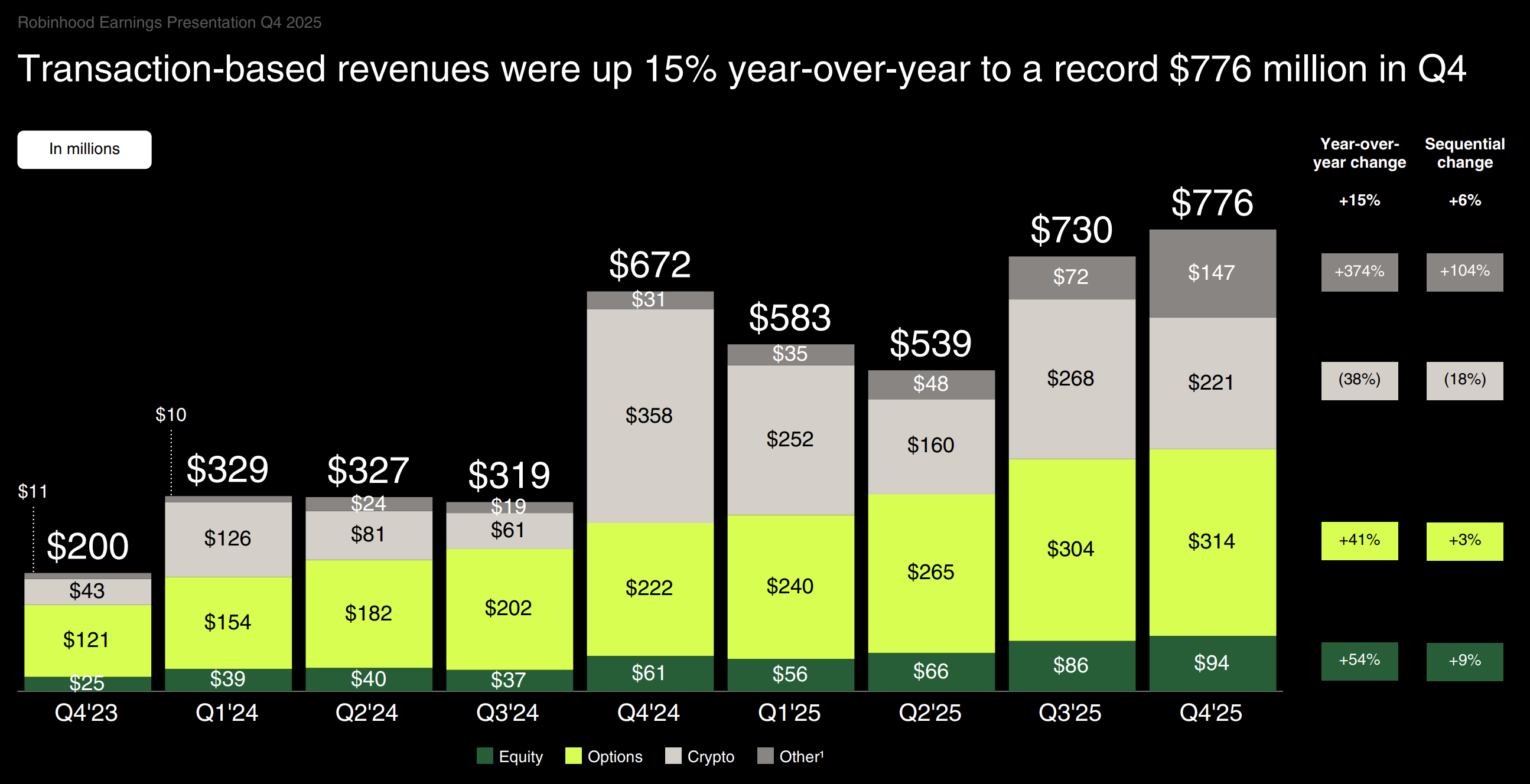
Image source: Robinhood Markets.
The total value of all cryptocurrencies in circulation stands at $2.5 trillion as I write this, which is down sharply from the 2025 peak of $4.4 trillion. The Trump administration’s pro-crypto policies haven’t created much tangible value for the industry, and since most coins and tokens still lack a true use case, they have struggled to hang onto their post-election gains.
None of the major coins have escaped the carnage, not even Bitcoin or Ethereum, which are both down more than 40% from their all-time highs. These steep losses are likely to keep many investors on the sidelines, which could result in a further reduction in Robinhood’s crypto transaction revenue.

Today’s Change
(-0.94%) $-0.70
Current Price
$74.20
Key Data Points
Market Cap
$67B
Day’s Range
$71.70 – $75.15
52wk Range
$29.66 – $153.86
Volume
751K
Avg Vol
28M
Gross Margin
94.96%
Robinhood’s valuation leaves room for further downside
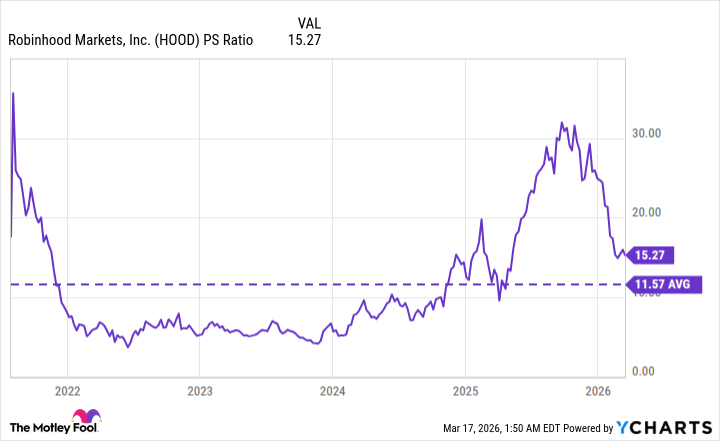
Robinhood stock peaked at more than $150 last October. At the time, its price-to-sales (P/S) ratio had soared to more than 30, which was almost triple its average of about 11.5 since the stock went public in 2021. Therefore, its valuation was completely unsustainable.
Despite the 51% decline in the stock during the past few months, its P/S ratio is still at an elevated level of 15.3.
HOOD PS Ratio data by YCharts
That means Robinhood would have to decline by a further 25% just to trade in line with its long-term average P/S ratio of 11.5. I’m not suggesting that will happen for certain, but I will say a high valuation reduces the odds of a rally in the near future, especially with one of the company’s core revenue drivers — crypto trading — in decline.
On a more positive note, Robinhood’s entry into the prediction market sector (in partnership with Kalshi) has expanded the company’s reach, because it lets clients bet on the outcome of sports matches, elections, and more. Robinhood ended the fourth quarter of 2025 with $435 million in annualized revenue from its prediction business, which more than tripled from the third quarter just three months earlier.
The prediction business could help Robinhood attract more clients, which would be good news considering its monthly active user base declined last year. But there is one caveat: According to research by The Motley Fool, the overwhelming majority of sports bettors lose money over time, which isn’t ideal if Robinhood is trying to attract repeat customers.
In summary, I think further downside is the path of least resistance for Robinhood stock.

