
Dire warnings about oil supplies are coming from everywhere lately as the Strait of Hormuz remains largely closed while President Donald Trump’s trip to China failed to produce a breakthrough to reopen the critical waterway.
While investors have been trading on hopes that the Iran ceasefire will remain intact, there is little sign that the oil trade will return to normal soon, forcing them to reckon with the reality of worsening shortages and an imminent tipping point ahead.
JPMorgan predicted that commercial oil inventories in the developed world could “approach operational stress levels” by early June. Saudi Aramco said global inventories of gasoline and jet fuel could reach “critically low levels” ahead of the summer.
The International Energy Agency warned the world is drawing down oil inventories at a record pace, with 164 million barrels released by governments and industry as of May 8.
“Rapidly shrinking buffers amid continued disruptions may herald future price spikes ahead,” IEA said in its lately monthly report.
The U.S. and Israel launched their war on Iran two and a half months ago, and analysts expected the Strait of Hormuz to reopen by the end of May or early June.
That’s looking less likely as Iran attacks ships in the Persian Gulf while the U.S. military is still enforcing a blockade on Iranian oil. Meanwhile, the Navy’s efforts to reopen the strait with warships is on hold.
U.S. Navy
“But if the Strait remains effectively closed and commercial oil inventories in the OECD continue to be run down at the same pace as they were in April, oil stocks could reach critically low levels by the end of June,” Hamad Hussain, climate and commodities economist at Capital Economics, said in a note on Wednesday.
“That would be consistent with Brent crude prices reaching an all-time nominal peak, and could require more disorderly and economically damaging cuts to oil demand.”
He estimated oil prices could top $130-$140 a barrel next month if the strait remains closed and inventory depletion rates remain steady.
On Friday, Brent crude futures gained more than 3% to close at $109.26 a barrel as China offered no hints that it would lean on ally Iran to normalize tanker traffic.
For now, oil futures haven’t reached doomsday levels. That’s due to ample supplies at sea when the war started, record releases from strategic oil reserves, and a sharp drop in Chinese oil imports as it draws on its own stockpiles, according to Hussain.
More supplies from oil inventories could be released. But they cannot fall to zero as certain volumes are needed to maintain pressure within storage systems, and the daily flow of releases is limited.
In addition, 1 billion barrels of oil is estimated to have been lost already, dwarfing the IEA’s planned total release of 400 million barrels.
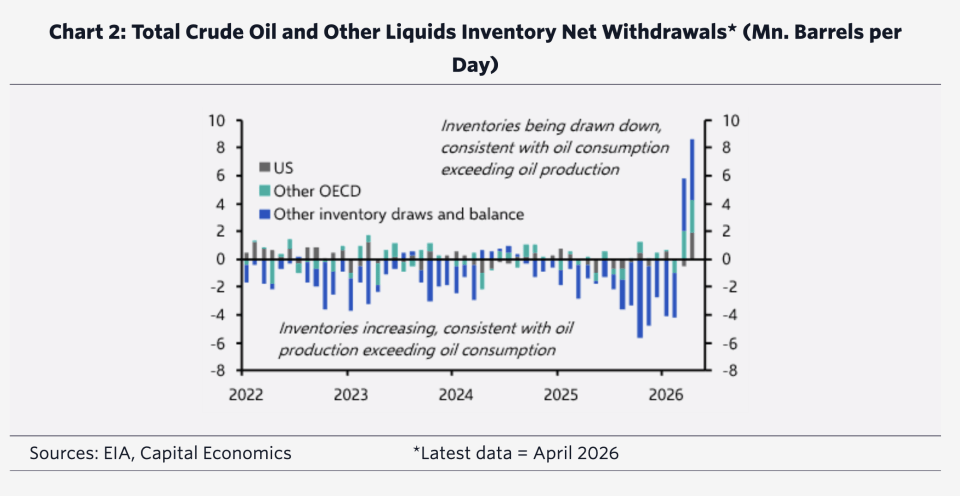
Efforts to clamp down on oil demand could intensify, and some countries in Asia have already imposed rationing measures.
“But given the extent of supply losses from the Middle East, the risk of a ‘non-linear’ adjustment in demand and prices will continue to grow for as long as the Strait of Hormuz remains effectively closed,” Hussain added.
In other words, rather than oil prices following a straight-line trajectory higher, they could instead go parabolic, looking more like the curved end of a hockey stick.
Similarly, analysts at UBS also said oil inventories are approaching record lows, warning that “buffers have now largely been exhausted.”
As stockpiles go even lower, UBS said oil prices could become more volatile and highlighted the “risk of panic buying if physical dislocation intensifies and the Strait of Hormuz remains closed.”

