
Can you buy your college aged child a house to live in for college using a 529 plan?
This question is about qualifying 529 plan expenses.
Buying a condo or house near campus is a popular move for parents who want to save on dorm costs and maybe turn a profit when they sell after graduation. The logic seems airtight: a 529 plan can pay for room and board, and housing is room and board, so why not let the account cover the mortgage? The short answer is maybe.
The longer answer is that you can use 529 money toward housing in a narrow set of circumstances, but doing so can erase the very tax advantages that make a 529 worth using in the first place.
Here is how the rules actually work, and where families get tripped up.
Would you like to save this?
Mortgage Payments And Other Direct Home Ownership Payments Don’t Qualify
In simple terms – a mortgage payment, property taxes, and insurance are all homeownership expenses, NOT education expenses.
When a parent buys the property and signs the mortgage, the debt belongs to the parent, not the student. The student is not paying a housing cost. Rather, the parent is paying down a loan.
The problem does not disappear if the student owns the home and holds the mortgage. A mortgage payment is still a payment on a loan rather than a payment for housing.
The IRS treats paying a mortgage as a non-qualified expense regardless of whose name is on the note. Pull 529 money to make that payment and the earnings portion of the withdrawal becomes subject to ordinary income tax plus a 10% penalty.
There is also a double-dipping rule worth knowing. Even in a scenario where a mortgage payment somehow counted, using 529 funds to make it would block you from claiming the home mortgage interest deduction on the same dollars.
The tax code does not let you take two tax breaks for one expense.
Renting A Home To Your Student (And The Catches)
The one legitimate path runs through renting the house to your student. If your child pays you rent, the rent itself can qualify as a room and board expense that 529 money pays for. You, as the landlord, can then use your rental income to cover your home’s expenses.
On paper, this turns a non-qualified mortgage into a qualified housing cost.
Catch 1 – Accounting For The New Income
The catch is on your side of the ledger. The rent your child pays you is rental income, and you have to report it on your tax return. So while the student takes a tax-free 529 distribution to pay the rent, the parent now has taxable income in roughly the same amount. In most cases, parents end up paying more in income tax through this arrangement.
A qualified 529 distribution normally avoids federal income tax and the 10% penalty on earnings, but here you are simply moving the non-existant tax bill from the student to your rental income – likely at a higher income tax rates than your as well.
Yes, you can deduct rental expenses against that income (mortgage interest, property taxes, insurance, utilities, maintenance, repairs, HOA or condo dues, and depreciation). That softens the blow, up to any limits (see Catch 2 and 3 below).
And remember, any depreciation you claim along the way gets recaptured and taxed when you eventually sell the property.
Catch 2 – Fair Market Value Rent
The rent also has to be “real” if you want to deduct your expenses and carry-forward any deductible losses. Under Rule IRC §280A(d) and IRS Publication 527: a day a family member who occupies the property counts as personal use by you, which triggers the limitation that caps deductions at rental income (no deductible loss) unless:
- the relative uses it as their main home and
- Pays a fair rental price.
You must meet both conditions so the property is treated as an ordinary rental. Basically you can’t discount the rent for your child.
It must reflect fair-market value for a comparable property — similar size, location, and amenities. The cleanest way to set it is a local rental survey, which a college housing office can sometimes provide.
Catch 3 – Cost of Attendance
The third thing to be mindful of is that your child cannot pay more than the certified cost of attendance for off campus housing. Every school publishes a number, and your maximum allowed cannot exceed it. And it may not be enough money to reach the fair market value rent in Catch 2.
For example, the University of Arizona publishes off-campus housing costs of be $12,750 per academic year (roughly 10 months). That breaks down to $1,275 per month.
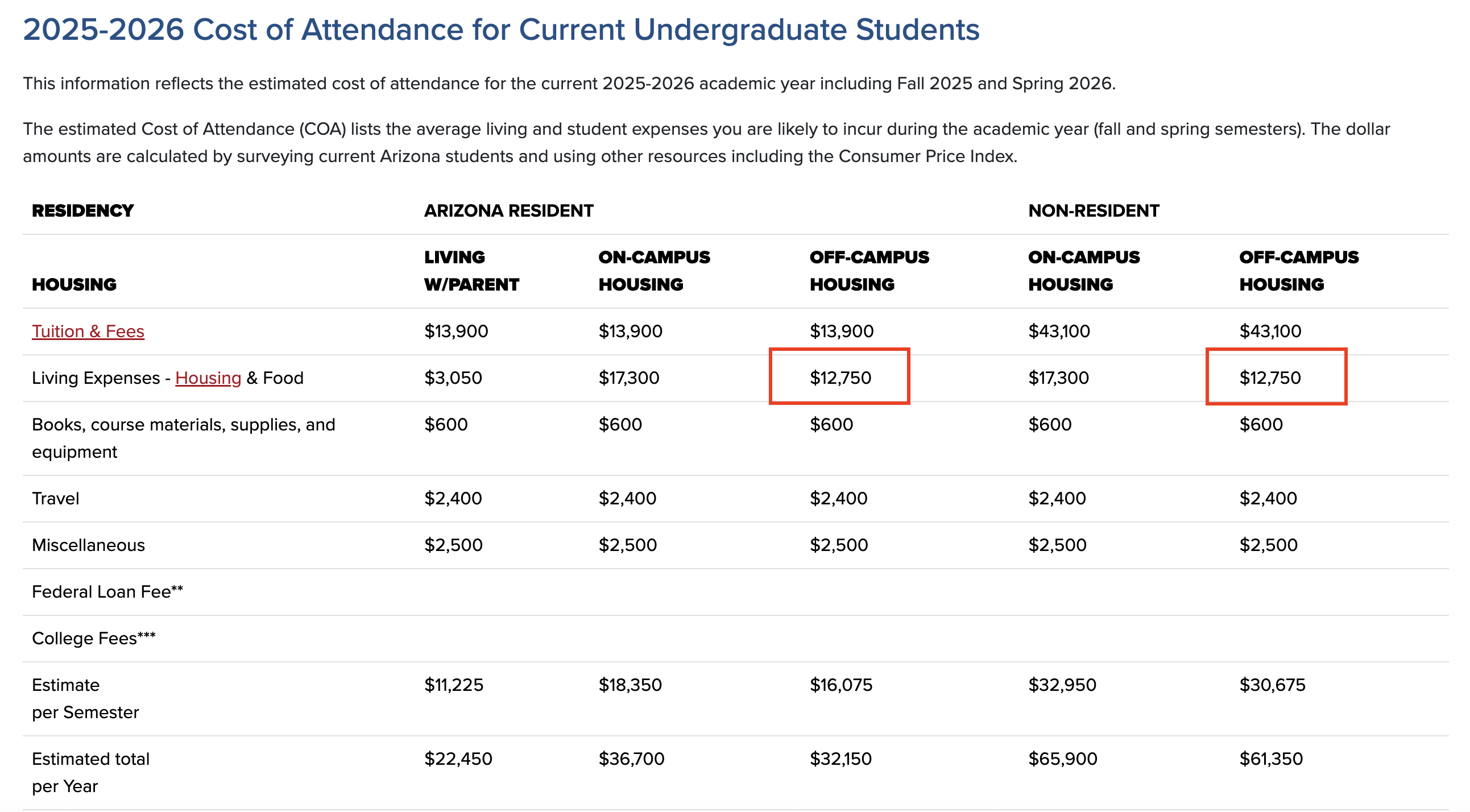
That may not be enough to make the entire situation work financially, but it’s the maximum allowed to be withdrawn from the 529 plan to be considered a qualifying expense.
How This Impacts Your College Finances
For families weighing this strategy, the practical question is whether the tax math comes out ahead. Often it does not.
The headline appeal (tax-free 529 money flowing toward a house you own) runs into the reality that rental income is taxable and that the deductions are capped if you rent to your own child at below market rents. Run the numbers before committing, ideally with a tax professional, because the answer depends on your tax bracket, the property’s expenses, and what the property costs.
There are also limits on how much rent can qualify, no matter how the lease reads. The student’s rent counts as a qualified 529 expense only up to the college’s published room and board allowance for students living off campus, found on the school’s cost of attendance. That off-campus figure is typically higher than the at-home allowance but is still a hard ceiling. Any 529 distribution above it becomes non-qualified, with tax and the 10% penalty on the earnings.
Enrollment status matters too. The student must attend at least half-time for rent to qualify, and that includes the summer. If they are not enrolled at least half-time over the summer term, rent paid for those months does not qualify and you cannot fix it by waiving summer rent, since that would drop the annual rent below fair market.
One more consideration sits outside the tax code. If the parent owns the home, it can count against them for need-based financial aid. The FAFSA only ignores a parent’s primary residence and an independent student’s primary residence from the asset calculation, but there is no equivalent protection for a second home or rental property. That asset could significantly reduce any financial aid your child qualifies for.
People Also Ask
Can I use a 529 plan to pay the mortgage on a house I bought for my child near campus?
No. A mortgage payment is repayment of a loan, not a housing cost, so it isn’t a qualified room and board expense — even if your child holds the mortgage. Using 529 money for it triggers income tax plus a 10% penalty on the earnings.
Is there any legal way to use 529 money toward a home I own?
Yes. Your child can pay you fair-market rent and cover it with 529 funds, which qualifies up to the college’s published off-campus room and board allowance. But the rent is taxable income to you, which usually erases most of the tax benefit.
Does my child have to be enrolled full-time for the rent to qualify?
No, but they must be enrolled at least half-time — including during the summer. If they drop below half-time in any term, rent paid for those months stops qualifying as a 529 expense.
Related Articles
What Are Qualified Expenses For A 529 Plan (And What Doesn’t Count)?
How Much Should You Have In A 529 Plan By Age
How Grandparents Can Save and Gift Money for a Grandchild’s College Education
Editor: Colin Graves
The post Thinking of Using Your 529 Plan to Buy Your Kid a House? Here’s What The Rules Say appeared first on The College Investor.

