
The Nasdaq-100 is made up of the 100 most valuable companies listed on the Nasdaq stock exchange, excluding banks and financial institutions. It has a very high degree of exposure to the “Magnificent Seven,” a group of technology companies operating at the forefront of revolutionary industries like artificial intelligence (AI).
Unfortunately, those tech giants delivered a sluggish performance during the first half of 2026, which is partly why the Nasdaq-100 is down 3% from its all-time high as I write this (June 30).
The Invesco QQQ Trust (QQQ 1.73%) is an exchange-traded fund (ETF) that tracks the performance of the Nasdaq-100 by holding the same stocks. Should investors buy it while the index is trading at a discount? History offers some very clear guidance.
Image source: Getty Images.
A sluggish year for America’s top growth stocks
The Nasdaq is often the exchange of choice for small technology companies looking to go public, because it offers lower fees and fewer compliance hurdles compared to alternatives like the New York Stock Exchange. Some of those budding companies went on to become the trillion-dollar giants that now make up the Magnificent Seven, which together represent a whopping 34.9% of the entire value of the Nasdaq-100 index.
|
Stock |
Invesco ETF Portfolio Weighting |
|---|---|
|
1. Nvidia (NVDA 1.39%) |
7.60% |
|
2. Apple (AAPL +4.88%) |
6.80% |
|
3. Alphabet (GOOG 0.37%)(GOOGL 0.23%) |
6.18% |
|
4. Microsoft (MSFT +1.69%) |
4.52% |
|
5. Amazon (AMZN +0.55%) |
4.08% |
|
6. Tesla (TSLA 7.35%) |
3.09% |
|
7. Meta Platforms (META 4.80%) |
2.66% |
Data source: Invesco. Portfolio weightings are accurate as of June 28, 2026, and are subject to change.
Unfortunately, the Magnificent Seven stocks delivered sluggish returns during the first half of this year. In fact, each of them underperformed the Nasdaq-100. The worst of the bunch is Microsoft, which has plummeted by more than 23%.
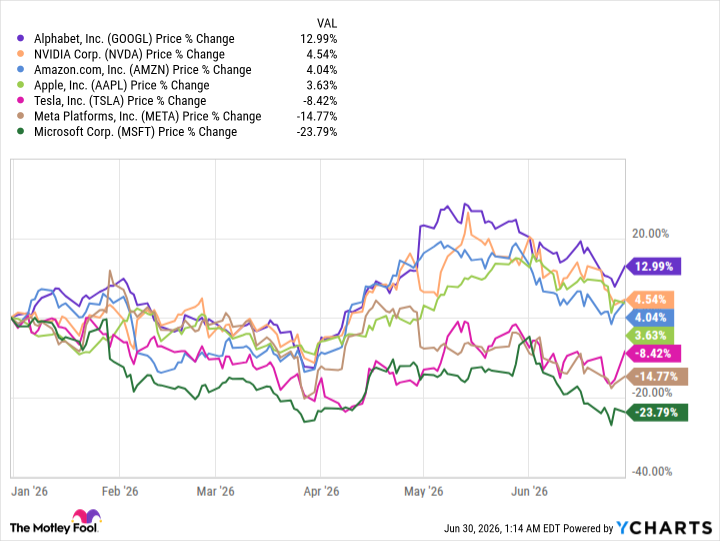
Data by YCharts.
On the bright side, the Nasdaq-100 also holds positions in soaring semiconductor stocks like Micron Technology, Advanced Micro Devices, Intel, Applied Materials, and Lam Research, which have each more than doubled this year. Their performance is offsetting some of the sluggishness in the Magnificent Seven, which is a key reason why the Nasdaq-100 isn’t down even more.
There is currently more demand for AI chips and infrastructure than those companies can possibly supply, which is why they have experienced such strong gains. This imbalance is likely to persist for the foreseeable future, which should buoy their share prices.
History is clear about what happens over the long term
Stock market sell-offs can be unnerving, and the uncertainty of what might come next often keeps many investors on the sidelines. However, history suggests they offer the best buying opportunities, because the market typically trends higher over the long term.
The Invesco QQQ ETF has delivered a compound annual return of 11% since it was established in 1999, even after accounting for every sell-off, correction, and bear market along the way. In fact, the ETF has endured five bear markets (peak-to-trough declines of 20% or more) over the last 27 years, triggered by events like the bursting of the dot-com internet bubble in 2000, the global financial crisis in 2008, and the COVID-19 pandemic in 2020.

Today’s Change
(-1.73%) $-12.57
Current Price
$712.60
Key Data Points
Day’s Range
$707.56 – $730.83
52wk Range
$549.58 – $748.65
Volume
51.1M
Since the Nasdaq-100 climbed to new highs after each of those drawdowns, investors who bought the Invesco ETF in the face of extreme uncertainty would have done exceptionally well in the long run. The current drawdown in the index — which is just 3% as I write this — is far less severe, but history suggests investors with a time horizon of five years or more are likely to earn a positive return if they use it as a buying opportunity.
Most of the Magnificent Seven stocks are entering the second half of 2026 at extremely attractive valuations. Nvidia, for example, is trading at a price-to-earnings (P/E) ratio of just 29.8, which is less than half its 10-year average. Microsoft, Meta, Alphabet, and Amazon each have a P/E ratio of below 30, so they are cheaper than the Nasdaq-100, which trades at a P/E of 34.1.
In my opinion, Wall Street won’t be able to ignore the value that’s on offer in some of America’s highest-quality stocks for much longer. That could lead to a recovery with the potential to lift the Nasdaq-100 to a new record high.
Anthony Di Pizio has no position in any of the stocks mentioned. The Motley Fool has positions in and recommends Advanced Micro Devices, Alphabet, Amazon, Apple, Applied Materials, Intel, Lam Research, Meta Platforms, Micron Technology, Microsoft, Nvidia, and Tesla. The Motley Fool recommends Intercontinental Exchange and Nasdaq. The Motley Fool has a disclosure policy.

