
Space Exploration Technologies (SPCX -2.25%) was a stock that many were skeptical of when it went public. While there was a sound business behind it, its early $2 trillion market cap seemed a bit suspect. Fast-forward a few months from its initial public offering to today, and after some notable ups and downs, its market cap sits at about $2 trillion. However, what has changed along the way is the market’s perception of the business.
While I was skeptical of SpaceX’s financial viability as a $2 trillion company, it recently showed investors why it deserves that valuation, primarily through its incredible growth. This is coming from business segments that some investors might not have expected, and it could be the factor SpaceX needs to drive it to new highs over the next few years.
But where will SpaceX stock be in three years? I think it could be trading at $375 per share, about two and a half times today’s price. If it can deliver returns like that, then it makes for a screaming buy now. So, how will SpaceX get there? Let’s take a look.
Image source: Getty Images.
SpaceX’s growth will come from non-space places
If you ask the average person what SpaceX does, they’ll likely talk about the fact that it launches rockets that put payloads into space, and then lands those launch platforms back on Earth for reuse. That’s entirely accurate, but it overlooks the company’s higher-growth segments.
In the third quarter, SpaceX’s space segment revenue rose from $1.67 billion to $1.77 billion year over year, or about 6% growth. That’s not impressive at all and would have many investors questioning it as a stock pick. However, SpaceX’s space business isn’t what’s exciting.
Its two other business segments are. SpaceX’s connectivity and super intelligence (SI) divisions are the two reasons to invest in SpaceX.
SPCX Space Exploration Technologies
$145.23-$3.35 (-2.25%)
NASDAQ · As of 4:00 PM ET 10/28/26
Connectivity includes the Starlink broadband service, which gives its users access to satellite-based internet nearly anywhere in the world. This division’s revenue rose from $3.1 billion in the prior-year quarter to $5.25 billion this time. That’s a 69% growth rate. Furthermore, connectivity generated $2.4 billion in operating income and was the primary reason SpaceX was profitable in Q3. This service should continue to grow at a strong pace and will help make SpaceX’s stock a market-crushing one.
Lastly is super intelligence, which used to be called the artificial intelligence (AI) division. This segment is a new addition to SpaceX: Previously, it was xAI, a separate Elon Musk-helmed company, but Musk had SpaceX buy xAI back in February, ahead of the IPO. However, the super intelligence segment’s growth has been simply incredible. In Q3, revenue rose 830% year over year to $7.56 billion, and while another acquisition it made along the way somewhat influenced that figure, it’s still doing great overall.
The reality is that SpaceX isn’t just a rocket company; it’s an internet and AI business. This is what will drive the stock to new heights, but how far can it take it?
Modeling SpaceX is difficult
Because SpaceX hasn’t been public for a year, we don’t have much information regarding the seasonality of its business. Furthermore, we have no idea whether its AI revenue will continue to expand as it has. However, CEO Musk commented that he expects SpaceX’s annualized recurring revenue run rate to reach $500 billion to $1 trillion by the end of 2027. That’s a bold assertion, but Musk is no stranger to those.
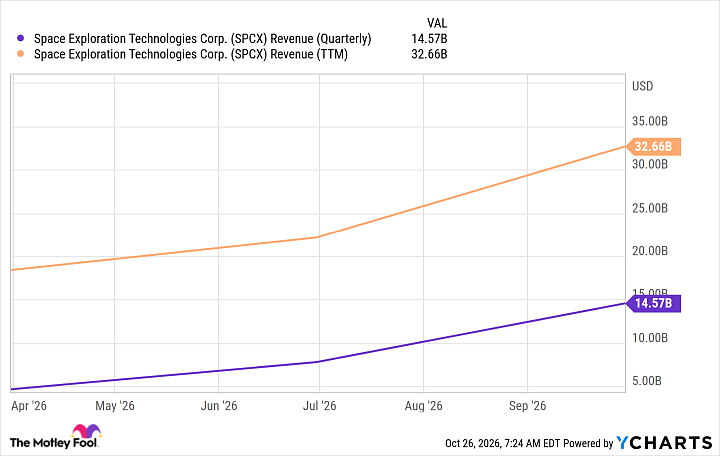
SPCX Revenue (Quarterly) data by YCharts.
He’s known to make overly ambitious projections, but I do think this one could be within reach in a couple of years due to strong AI growth. So, if SpaceX could generate $500 billion in revenue three years from now and trades at that point at a reasonable 10 times sales, that would make it a $5 trillion company, or about 150% higher than today’s market cap. That would be a $375 stock, which would make SpaceX a no-brainer buy at today’s levels.

