
When most investors look at the Vanguard S&P 500 ETF (VOO 0.06%), they see nothing more than a broad-based, low-fee index fund. What they overlook, however, is a deeper truth hiding in plain sight: Investing in the S&P 500 doesn’t just give you access to the stock market. It also makes you an owner of every pillar supporting the American economy.
Image source: Getty Images.
The S&P 500 is designed to be self-correcting
The S&P 500 index isn’t a static list of companies. When you buy the Vanguard S&P 500 ETF, you aren’t buying a snapshot. You’re accessing a mechanism that automatically replaces losers with winners year after year.
While most investors waste their time trying to predict the future, index funds outsource this problem to the market itself. The S&P 500 has survived the dot-com collapse, the 2008 financial crisis, a global pandemic, and the highest interest rate cycle in 40 years. As the chart below shows, each time the market proved resilient and bounced higher after bottoming.
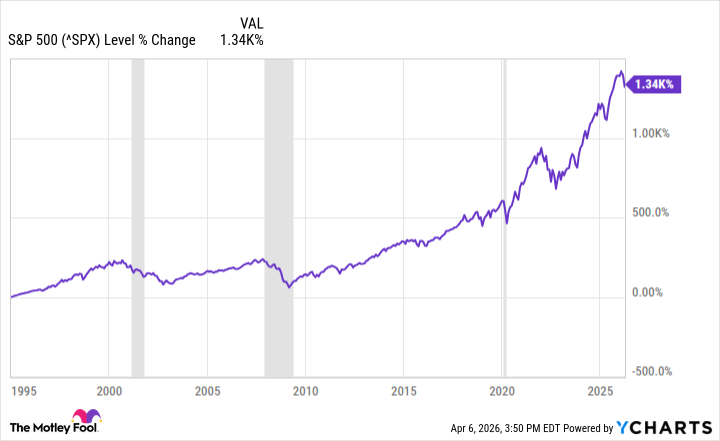
^SPX data by YCharts
Don’t bet on individual stocks
It’s best to think about the S&P 500 as a pyramid with layers. From the foundation to the rooftop, the index contains the cloud computing backbone of the AI economy (Amazon, Alphabet, Microsoft), the payment networks that process charges every day (Visa, Mastercard), the pharmaceutical companies that manufacture blockbuster drugs (Eli Lilly), and the defense contractors governments around the world rely on for high-stakes intelligence (Palantir Technologies).
In other words, the S&P 500 isn’t a collection of growth stocks. The index is a toll booth collecting fees on civilization’s most essential highways.

Today’s Change
(-0.06%) $-0.40
Current Price
$624.62
Key Data Points
Day’s Range
$623.74 – $626.97
52wk Range
$467.33 – $641.81
Volume
127K
Time is the market-beating variable most investors can’t produce
The reason most investors ultimately underperform the S&P 500 isn’t that they choose the wrong stocks. It’s that they don’t hold on to their positions long enough.
The Vanguard S&P 500 ETF makes this kind of structural patience much easier because it isn’t a story that changes with each earnings call. In other words, investing in the S&P 500 doesn’t involve a narrative that you can get bored with or lose trust in.
There are no corporate governance problems, no earnings surprises, and no downgrades from sell-side analysts to panic about. In a market full of macro indicators that fluctuate by the hour, the investor who simply watches from a distance is usually able to accrue a compounding advantage that trading algorithms fail to replicate in the long run.
This is all to say that the best financial decisions you can make are rarely the most exciting ones. Instead, buying optionality through the S&P 500 and increasing your position for a long time allows you to generate meaningful, durable wealth both quietly and cheaply.
Adam Spatacco has positions in Alphabet, Amazon, Eli Lilly, Microsoft, and Palantir Technologies. The Motley Fool has positions in and recommends Alphabet, Amazon, Mastercard, Microsoft, Palantir Technologies, Vanguard S&P 500 ETF, and Visa. The Motley Fool has a disclosure policy.

