
The Federal Reserve’s G.19 consumer credit release published September 8 put outstanding student loan debt at $1,858.2 billion at the end of the second quarter of 2026. That is up $55.6 billion from $1,802.6 billion a year earlier, a 3.1% increase. This is also the first time the national student loan balance has gone above $1.85 trillion.
Total consumer credit grew at a 4.2% seasonally adjusted annual rate in July to $5.19 trillion. Federally held consumer credit (Direct Loans, Perkins, and Ed-held FFEL) was $1,605.6 billion, roughly flat since March, even as millions of borrowers move onto new repayment plans.
It’s important to remember that Q3 is typically when the federal balance sheet sees the biggest jump in student loan debt as fall enrollment hits the books.
Would you like to save this?
Why It Matters
The amount of student debt in the United States is still growing, but the pace has changed. Annual growth peaked at $104.3 billion in 2011 and has not topped $57 billion in any year since 2020, well underway before the new graduate and parent borrowing caps took effect.
That deceleration is mostly a lending story rather than a repayment story. Undergraduate enrollment growth has slowed, Grad PLUS is gone for new borrowers, and origination volume has fallen with it.
For families, the typical 2026 graduate still borrows about $43,500. It’s just that there are fewer students to enroll in college changing the overall aggregate numbers.
Two Decades Of Growth
Student loan debt has more than tripled since 2006. The shape of that growth is the story: steep through the 2010s, then flattening sharply in recent years.
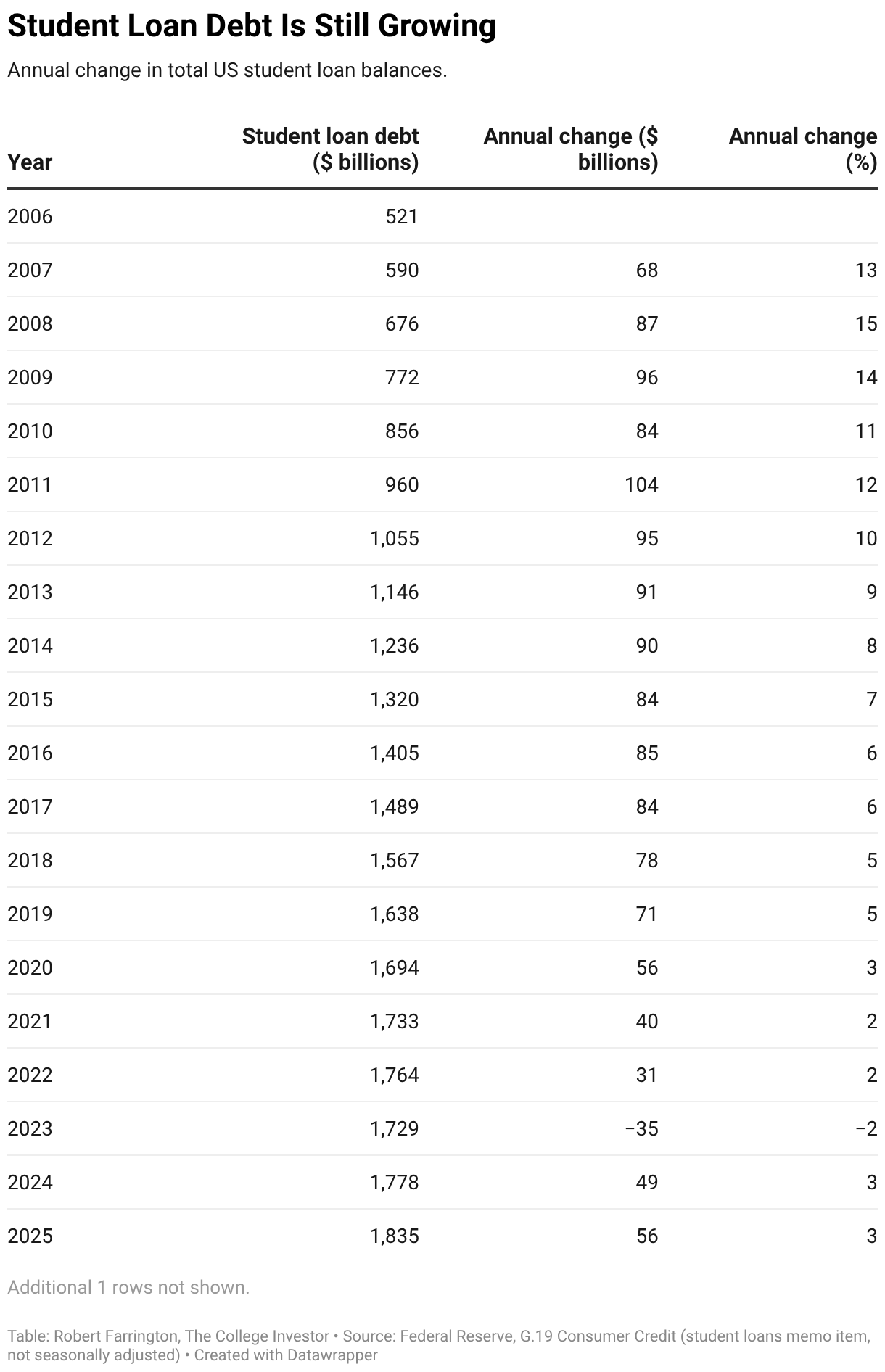
2023 remains the only annual decline in the series, reflecting federal discharges rather than ordinary repayment. This is a reminder of the myriad of Biden-era loan forgiveness programs that saw upwards of $188B forgiven.
How This Connects
It’s important to remember that the $1.86 trillion total says nothing about how individual borrowers are handling their own debt.
The average federal balance is $39,547 against a median of $20,281, spread across 42.8 million borrowers. A gap that wide means a small group of very large balances pulls the average up.
The total also hides who has stopped paying: 7.7 million borrowers were in default as of March 2026. These individual borrowers face the worst situation because collection costs always exceed the cost of repayment, and these borrowers face the indirect costs of poor credit as well.
What’s Next
Third-quarter data is due in December and it will be the first read that includes new student loan originations under the new OBBBA limits. The signal to watch is whether the usual Q3 disbursement surge (roughly $30 billion in each of the last two years) comes in materially smaller, which would tell you the caps are reshaping borrowing rather than just redirecting it.
Editor: Colin Graves
The post Student Loan Debt Reaches $1.86 Trillion, Up $55.6 Billion From A Year Ago appeared first on The College Investor.

