
For the past several years, borrowers with defaulted federal student loans have had an unusual amount of breathing room. The Department of Education paused the Treasury Offset Program in January 2026, which meant tax refunds were off the table as a collection tool for the entire 2026 filing season.
That window is closing. The Department has said involuntary collections restart once its new repayment system is in place, and the pieces are now falling into place — the Repayment Assistance Plan launched July 1, 2026, and borrowers pushed off SAVE were given 90 days from that date to choose something new.
Our reporting has garnishment and offsets ramping back up in the fall, which puts the returns you file in early 2027 squarely back in the crosshairs. There are already signs of movement: seniors with defaulted loans are facing Social Security withholding again, and that runs through the same Treasury Offset Program that takes tax refunds.
If you’re married and your spouse is the one carrying the defaulted loans, back child support, or old tax debt, this lands on you directly. When you file a joint return, the IRS doesn’t sort out whose refund is whose before handing it to the Treasury. It takes the whole thing, which is why understanding how tax offsets work matters before you file rather than after.
Form 8379, the Injured Spouse Allocation, is how you get your half back and it belongs on the short list of tax forms worth knowing before you file.
Who Is the Injured Spouse?
The name is misleading. “Injured” here has nothing to do with physical harm — it means financially harmed by your spouse’s debt, and it’s one of the more commonly misunderstood corners of the tax code.
Per the IRS, you may be an injured spouse if you file a joint return and all or part of your portion of the overpayment was, or is expected to be, applied to your spouse’s legally enforceable past-due federal tax, state income tax, state unemployment compensation debts, child support, or federal nontax debt — the last category being where defaulted student loans sit.
To qualify, IRS Publication 504 lays out two conditions. You must not be legally obligated to pay the past-due debt. And you must have either made and reported tax payments — withholding from your paycheck or quarterly estimated tax payments — or claimed a refundable credit on the joint return. It’s an “or,” not an “and.”
That refundable credit path matters more than people realize. If you had little or no withholding but claimed the Earned Income Tax Credit or the Child Tax Credit, you can still qualify as an injured spouse. If you live in a community property state, only the first condition applies at all.
In plain terms: you contributed something to that refund, and the government took it to pay a debt that isn’t yours. Your filing status is what pooled the money in the first place.
One important distinction. Injured spouse relief is not innocent spouse relief. Injured spouse (Form 8379) is about recovering your share of a refund that got offset. Innocent spouse (Form 8857) is about being released from liability for tax your spouse understated or failed to pay — closer to the territory of setting up an IRS payment plan than to refund allocation. The instructions are blunt: don’t file Form 8379 if you’re claiming innocent spouse relief.
What’s Changed For The 2027 Filing Season
A few things are worth knowing before you file a return covering tax year 2026, on top of the usual annual bracket and deduction adjustments.
Offsets are expected to be live again. The Treasury Offset Program restarted in May 2025 after a five-year pandemic-era pause, then got paused again on January 16, 2026. Under Secretary Nicholas Kent has previously said collections “will function more efficiently and fairly after the Trump Administration implements significant improvements to our broken student loan system.” Those improvements are the ones now rolling out across the federal loan system.
The Department has not published a hard restart date for the Treasury Offset Program, so treat fall 2026 as a working assumption rather than a confirmed calendar entry. But plan as though your 2026 refund is exposed, and check the refund schedule against how long an injured spouse claim actually takes.
You can now e-file Form 8379 by itself. This is a genuinely useful change. The IRS updated its instructions for tax year 2026 to allow Form 8379 to be filed electronically by attaching it to Form 1040-X even if you are not amending your return. Previously, filing on its own after a joint return had already processed meant mailing paper. If your tax software supports amended returns electronically, this should cut weeks off your wait.
A line reference was corrected. The instructions for line 17 now read “lines 28 through 30, and Part II of Schedule 3 (Form 1040)” — line 30 was missing before. Minor, but if you’re filling this out by hand instead of letting tax software handle it, use the corrected reference.
A second rehabilitation is coming, but not yet. The 2025 budget law gives borrowers a second chance to rehabilitate a defaulted loan, where prior rules allowed exactly one. Watch the date: for loans rehabilitated before July 1, 2027, the old one-and-done rule still applies. Starting July 1, 2027, a borrower can rehabilitate up to twice, which is after the 2027 filing season, and precisely why Form 8379 matters this year.
The form itself is still the November 2023 revision and the instructions are the November 2024 revision. The IRS is not republishing them; the tax year 2026 changes are posted separately on IRS.gov, so don’t assume a printed copy reflects them. Same caution applies to any older tax guidance you have saved.
How Much Money Could I Get Back by Filing Form 8379?
The IRS calculates your share by running a hypothetical “married filing separately” computation. It figures what your tax liability would have been on your income alone, credits you with the payments you made, and refunds the resulting overpayment. Your spouse’s share stays with the offset — the same mechanism that drives wage garnishment on defaulted loans, just applied to refunds.
That means the split is rarely 50/50. If you earned $70,000 and your spouse earned $15,000, you’ll get back substantially more than half. If your spouse out-earned you, expect less — and if you’re a two-earner household, it’s worth understanding how the tax code already treats married couples before you assume the math favors you.
For reference, the 2026 standard deduction is $16,100 for single and married filing separately, $32,200 for married filing jointly, and $24,150 for head of household. The IRS allocates the standard deduction between spouses in this calculation, so it isn’t a clean apples-to-apples comparison with actually filing separately.
Community property states work differently. If you live in Arizona, California, Idaho, Louisiana, Nevada, New Mexico, Texas, Washington, or Wisconsin, state law overrides the income-based split. Generally, 50% of a joint overpayment (excluding the Earned Income Credit) goes to non-federal tax debts — so a defaulted student loan or back child support typically eats half your refund regardless of who earned what. If that’s your situation, getting out of default is a far better use of your energy than filing this form annually.
For federal tax debts, the rules vary by state. The IRS points to four separate revenue rulings: Rev. Rul. 2004-71 (Arizona and Wisconsin), 2004-72 (California, Idaho, Louisiana), 2004-73 (Nevada, New Mexico, Washington), and 2004-74 (Texas). A community property state plus a federal tax debt is a conversation with a tax pro, not a guess — and possibly a case for an installment agreement with the IRS instead.
How To Fill Out Form 8379
The form runs two pages and four parts. Most people should let tax software walk them through it, but it helps to know what’s being asked.
Part I — “Should You File This Form?” is a short branching questionnaire that determines eligibility. Line 1 asks the tax year. Lines 2 through 9 walk through whether the debt belongs solely to your spouse and whether you made payments or claimed a refundable credit. Answer honestly — a “no” in the wrong spot means rejection, not just delay, and you’ll be back to tracking a refund that never arrives.
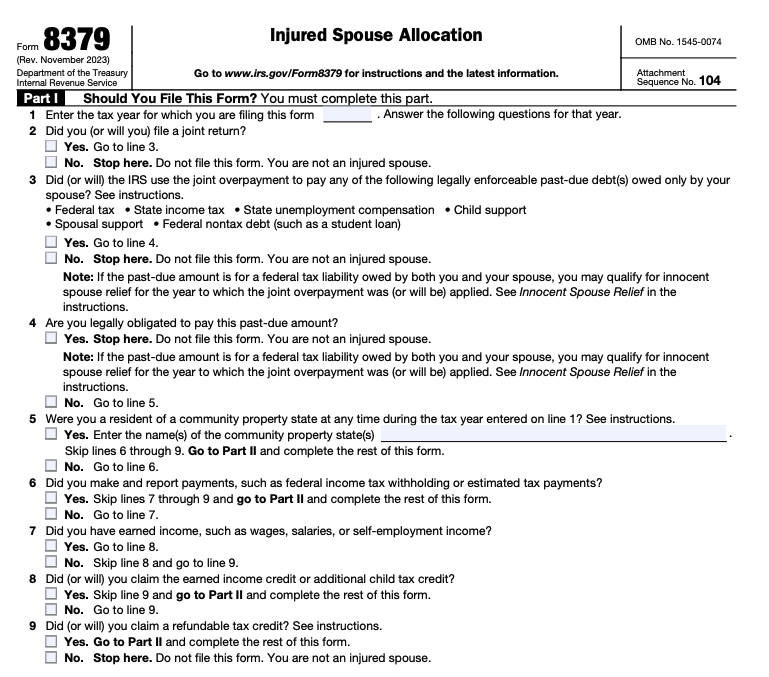
Part II asks about the joint return: names, Social Security numbers in the same order they appeared on the return, and which spouse is the injured one. Getting the name order wrong is one of the more common reasons these get kicked back, which is exactly the kind of error free filing options will catch for you.
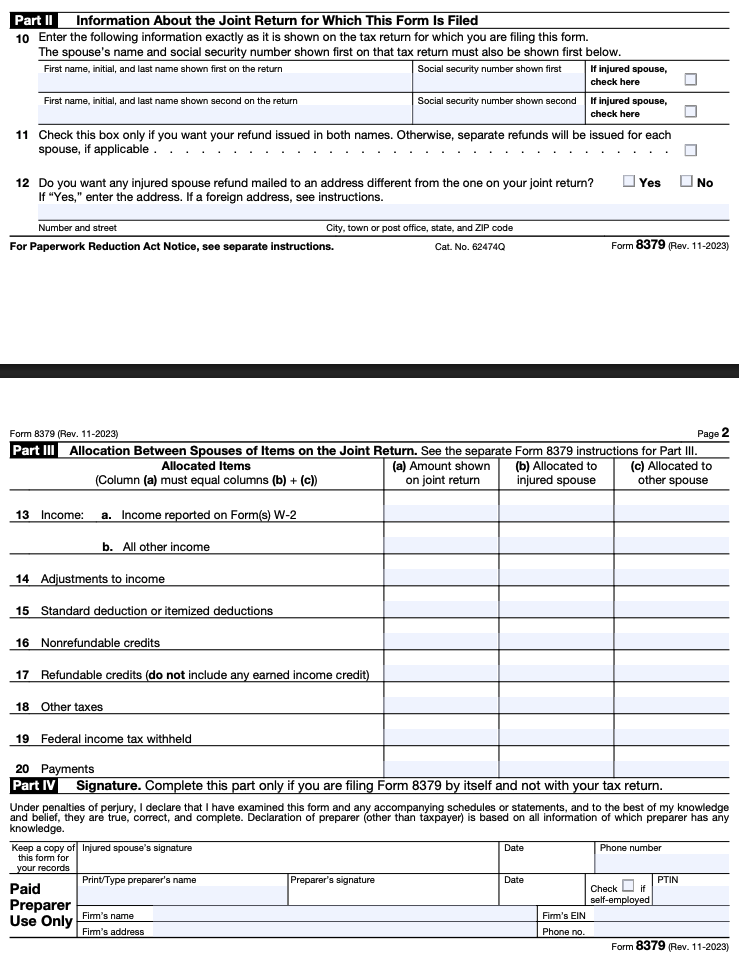
Part III is the allocation itself. You split income, adjustments, deductions, credits, other taxes, and federal income tax withheld into three columns: the amount on the joint return, the amount allocated to you, and the amount allocated to your spouse. Line 19 says to enter federal income tax withheld from each spouse’s income as shown on Forms W-2, W-2G, and 1099 — and you have to attach copies. If you have education expenses in the mix, your 1098-T matters here too.
Here’s what Part 3 looks like:
Part IV is your signature, required only if you’re filing Form 8379 on its own rather than attached to a return. If you’re filing it alongside an amended return, the 1040-X process governs the rest.
Most major tax software supports Form 8379, including TurboTax, H&R Block, FreeTaxUSA, and TaxSlayer. Support quality varies, so check our current tax software rankings before committing.
How Long Does It Take to Process Form 8379?
This is the part that frustrates people, and it’s worth setting expectations against the normal refund timeline. The IRS estimates:
|
How You File |
Processing Time |
|---|---|
|
With your joint return, electronically |
About 11 weeks |
|
With your joint return, on paper |
About 14 weeks |
|
By itself, after the joint return is processed |
About 8 weeks |
Those are estimates, not guarantees, and they run from when the IRS receives the form — not when you hit send. Backlogs push them longer. If you’re counting on that money, build in a cushion, and know that the “Where’s My Refund” tool often shows confusing status codes while an injured spouse claim is pending.
Note the counterintuitive part: filing the form by itself after your return processes is faster on paper (8 weeks versus 11), but you don’t see money until the joint return finishes processing first. Filing it with the return is still usually the better move — and it means one filing deadline to track instead of two.
When Should I File Form 8379?
Best case: with your joint return. Attach it and file electronically. Whenever Form 8379 is attached to a joint return, the instructions direct you to enter “Injured Spouse” in the upper left corner of page 1 — tax software handles this automatically when you e-file. This is the cleanest path and avoids a second round of processing.
If the offset already happened: file Form 8379 on its own. You don’t have to wait for a notice, and you don’t need to have received one. If you’re unsure whether a debt is even flagged, your loan servicer can usually tell you where the account stands.
The deadline is longer than most people think. You generally have three years from the due date of the original return (including extensions), or two years from the date you paid the tax that was later offset — whichever is later. Many summaries mention only the three-year rule, which can cost you a valid claim. Check the relevant year’s tax due dates to pin down your actual window.
You have to file it every year. Form 8379 is not a standing election. If your spouse’s debt is still outstanding next year, you file again next year — which is one more argument for fixing the underlying default instead.
If you want to know whether an offset is coming, call the Treasury Offset Program call center at the Bureau of the Fiscal Service: 800-304-3107 (TTY/TDD 866-297-0517). They can tell you whether a debt is flagged, though not the amount the IRS will take. Debt collectors assigned to defaulted loans can sometimes confirm the same information.
Alternatives To Filing Form 8379
Form 8379 works, but it’s a workaround. These are the actual fixes, and most of them run through resolving the default itself.
File separately. If you file married filing separately, your refund never gets pooled with your spouse’s, so there’s nothing to offset. The catch is cost. Filing separately bars the American Opportunity Credit, the Lifetime Learning Credit, and the student loan interest deduction outright.
It also generally bars the Earned Income Credit — with a narrow exception if you had a qualifying child living with you more than half the year and you either lived apart from your spouse for the last six months or were legally separated and not sharing a household at year-end. Run the numbers both ways before deciding; our breakdown of what each filing status actually costs is a reasonable starting point.
That said, there can be real upside to separate filing when loans are involved, because a borrower who files separately has only their own income counted in the payment calculation. Our full analysis of the math behind married filing separately for student loans walks through when it pencils out.
What changed is the surrounding math. RAP has no poverty-line exemption and no family-size adjustment — it’s a flat 1% to 10% of AGI by income band, reduced by $50 per dependent, with a $10 monthly minimum. Under IBR and PAYE, a borrower filing separately could still count a spouse in family size, which softened the tax hit. That cushion is gone. Re-run this for 2026 rather than assuming what worked under the older income-driven plans still holds.
Get the loan out of default. This is the permanent solution. Rehabilitation removes the default and takes you out of the offset system entirely — the regulation requires nine voluntary, reasonable and affordable monthly payments, each made within 20 days of the due date, during 10 consecutive months.
Consolidation is the faster route if you need out quickly, though it doesn’t erase the default from your credit report the way rehabilitation does. Remember the timing on the second rehabilitation: if you already used your one shot, that door doesn’t reopen until July 1, 2027.
Check whether forgiveness applies. Before you build a plan around annual Form 8379 filings, confirm the debt should exist at all. Borrowers regularly miss eligibility for one of the forgiveness and discharge programs, and public sector workers in particular should verify their PSLF standing. Parent PLUS borrowers have a narrower set of options and should check theirs early.
Request a review of the offset itself. If the debt is disputed, already paid, or you’re facing genuine hardship, there’s a separate challenge process. Our guide to stopping tax offsets due to student loan debt covers the paperwork and the deadlines.
Adjust your withholding. The blunt-force option: if the IRS never owes you a refund, there’s nothing to take. Dialing in your W-4 so you break even means you keep the money during the year instead of fighting for it afterward. It isn’t right for everyone — some people rely on the forced-savings effect of a refund — but it removes the problem entirely.
Frequently Asked Questions
Does filing Form 8379 hurt my credit?
No. Form 8379 is a tax form with no connection to your credit report. Your spouse’s defaulted loan already affects their credit; this form changes nothing either way.
Can I file Form 8379 if my spouse owes back child support?
Yes. Child support is one of the debts that triggers an offset, and it’s among the most common reasons people file — the same offset system handles both.
What if we already filed and the refund was taken?
File Form 8379 on its own. You have up to three years from the original return’s due date including extensions, or two years from the date the tax was paid, whichever is later. Confirm your year’s deadline before you assume you’re out of time.
Do I need to file it again if I filed last year?
Yes. It applies to a single tax year, so file again each year you need protection — or resolve the default and stop needing it.
Will Form 8379 stop the offset from happening?
It protects your share, not your spouse’s. Filing it with the joint return can keep your portion from being taken at all; filing after the offset means clawing it back. Either way, your spouse’s share still goes to the debt. The Taxpayer Advocate Service also warns that filing separately from your original return risks the refund being offset before your claim is processed — one reason understanding the offset process up front is worth the time.
I’m no longer married to that person. What now?
If the offset came from a joint return filed while you were married, Form 8379 still applies for that year. Once you’re filing single or head of household, the issue shouldn’t recur — see how filing status affects your return.
Where can I get more help with tax questions like this?
Our tax resource and help center covers filing, credits, deductions, and refund issues in one place.
Editor: Clint Proctor
Reviewed by: Chris Muller
The post Injured Spouse Relief: How To File Form 8379 And Protect Your Tax Refund In 2027 appeared first on The College Investor.

