
Author: Ben Fraser, President & CIO, Aspen Funds
Editor’s note from Peter: Aspen Funds is one of our sponsor partners. We asked them to share how they think about where to put capital when the economy is unpredictable. Their core business is real estate private credit, which is worth understanding whether or not you ever invest with them. As always, this is education, not a recommendation. Do your own due diligence. Here’s their take. Full disclosure at the end of the post.
When the economy is unpredictable and tumultuous, a few things happen.
The stock market (and retirement accounts) can have drastic fluctuations, often wiping out years of gains overnight.
People’s “risk meters” go into overdrive, keeping them in jobs they don’t like and scaring them away from continued investing. And in periods of high inflation, the future value of their savings is being chiseled away.
Navigating the complexities of a challenging economy without a crystal ball is tough. Knowing where to focus your investments to keep earning returns can be difficult.
Here’s something to consider. The best types of investments to focus on when the economy is unpredictable have two primary features: lower risk and income-producing.
Top Features for Investment Opportunities in an Unpredictable Economy
Lower Risk
Oftentimes, inexperienced investors view stock market investing as “low risk.” After all, if millions of other investors are doing this, it has to be safe, right? The truth is, the stock market has inherent volatility that many investors don’t consider.
And volatility kills the power of compounding. That’s why, when the economy is not stable, you want to focus on investment vehicles that are stable and carry lower risk.
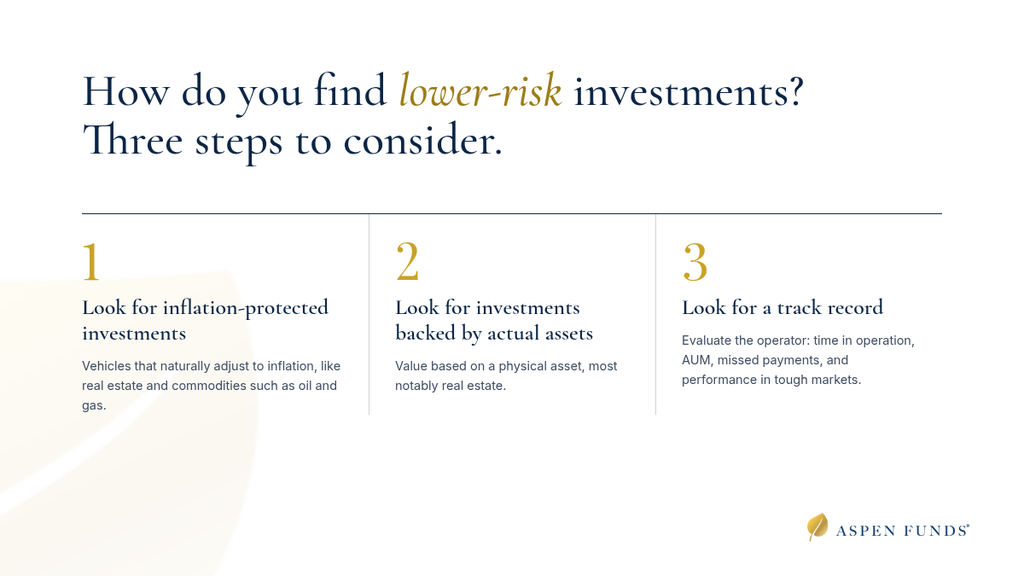
How do you find lower-risk investments?
Finding investments that are lower-risk may seem daunting. Of course, you need to do your own research and due diligence, but here are a few steps to consider that can help you identify opportunities that are less risky:
- Look for inflation-protected investments. When inflation is high, it can have a big impact on your cash. Let’s say your money is tied up in a 5-year investment that doesn’t adjust for inflation, like a fixed-rate bond. By the end of that period, you may have “technically” made money on your investment, but the value of the dollar has decreased, and your terms didn’t adjust with inflation. So in reality, you made much less. Looking for inflation-protected investments, or investment vehicles that naturally adjust to inflation, can mitigate a lot of risk and help protect your capital. One of the more common inflation-protected vehicles is real estate. Property prices and rents have historically tended to track inflation. Other asset classes that can serve as a hedge against inflation, because they aren’t as sensitive to public equity markets, are commodities like oil and gas.
- Look for investments backed by actual assets. Investments whose value is (at least partially) based on a physical asset are often less risky than investments where this isn’t the case. Venture capital, for example, is a riskier investment because you’re betting on the future success of a business. Owning a share of a valuable piece of artwork, on the other hand, gives you the collateral of the actual piece of art. Its value may change, but it is less likely to go to zero. Common investment vehicles that are backed by assets include art, collectibles, and, most notably, real estate. Real estate can include everything from multifamily syndications to industrial properties to mortgage note investing.
- Look for a track record. Aside from the actual investment opportunity itself, it’s also paramount to evaluate the risk associated with the operator of the investment. When the economy is unpredictable and you’re looking to lower risk, it’s especially important to invest with operators that have a solid track record. Key things to look for in a track record include length of time in operation, total assets under management, whether any return payments have been missed or delayed, past capital losses, and historic performance during challenging economic environments, like during Covid. While past performance doesn’t guarantee future performance, positive indicators in all these areas can help mitigate some risk.
Want to learn more about a private credit fund targeting 10-12% annual returns?
Learn about the Aspen Real Estate Private Credit Fund.
Target returns are not guaranteed. Available to accredited investors only.
Income-Producing
Finding investments that produce regular returns in the form of monthly or quarterly checks is always top of mind for investors. But this becomes especially important in periods of economic uncertainty.
Income-producing investments can help supplement earned income or provide a financial buffer if you hit any road bumps during an economic downturn.
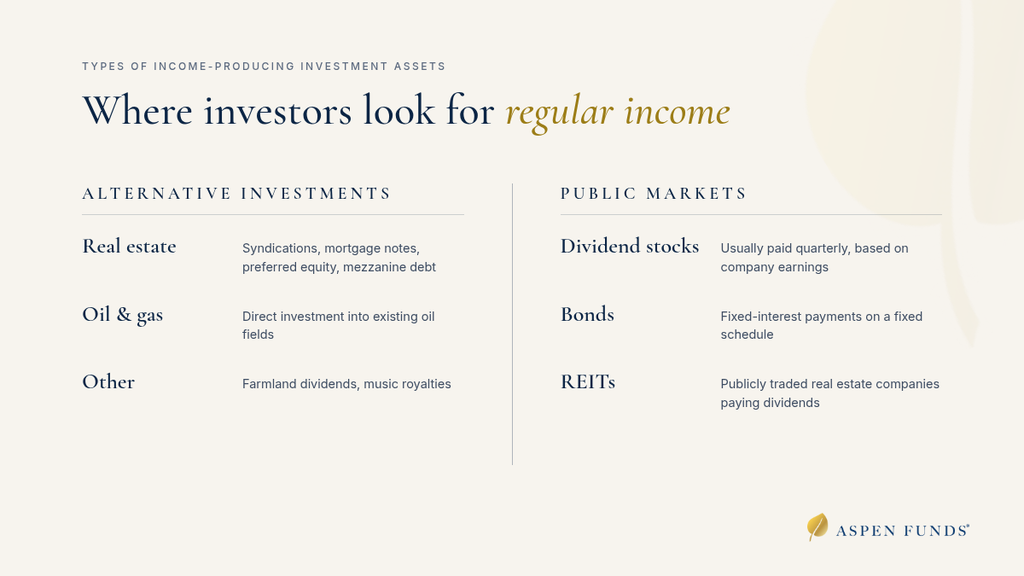
Types of income-producing investment assets
Alternative investments:
- Real estate. One of the easiest places to find investments that will generate regular income is real estate. There are crowd-favorite options like syndications in multifamily, commercial, and retail properties. There are also lesser-known real estate investments that can offer a different risk profile and more predictable cash flow, like mortgage notes or private lending strategies such as preferred equity or mezzanine debt.
- Oil & Gas. Investing directly into existing oil fields can produce strong yields. While these types of investments can have more volatility given the ties to commodity prices, generally the risk-adjusted returns can be compelling. And similar to real estate syndications, these types of investments are typically available to accredited investors.
Other less-common alternative investments that can produce income are things like investing in farmland that generates dividends or buying catalogs of music that produce royalties.
Public markets:
- Dividend stocks. Dividend stocks pay investors dividends, usually on a quarterly basis, based on company earnings. The dividend amount varies and is determined by the company’s board of directors each quarter.
- Bonds. Bonds are essentially loans to a government or corporation at a fixed interest rate. You receive payments at this fixed amount on a fixed schedule according to the loan terms.
- REITs. Real estate investment trusts are publicly traded shares in a company that owns physical real estate (like office buildings), collects rent from tenants, and distributes the majority of its earnings as dividends.
Why Invest with Aspen Funds
Aspen Funds is a macro-driven alternative investment firm providing private market investment opportunities to accredited investors in the U.S. Aspen focuses on middle market strategies with low correlation to public markets and attractive risk-adjusted return potential.
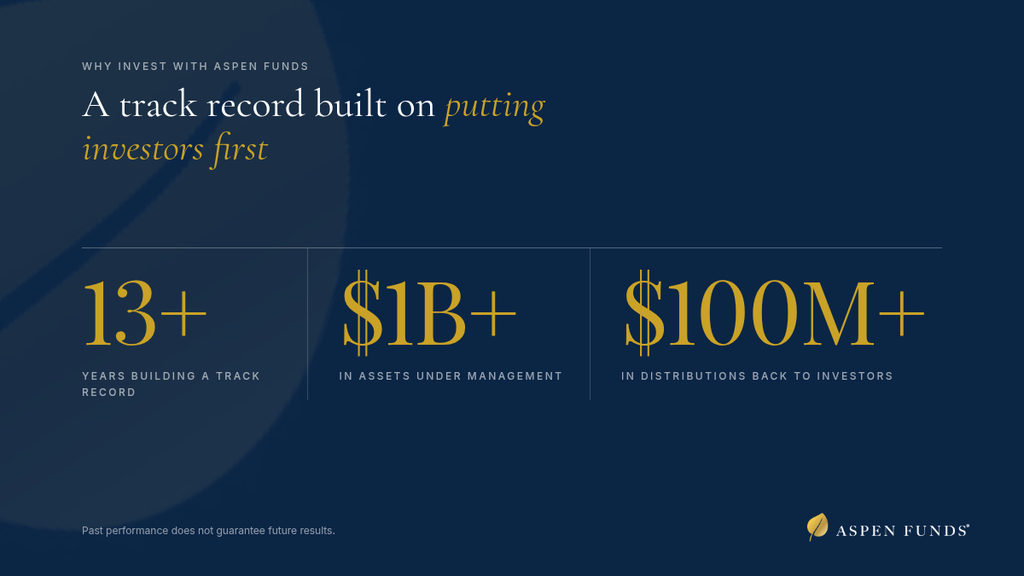
For more than 13 years, Aspen has built a track record of putting investors first and investing alongside them in every deal. This discipline has helped Aspen grow to more than $1 billion in AUM and has delivered more than $100 million in distributions back to investors.
Were these helpful in any way? Make sure to sign up for the newsletter and join the Passive Income Docs Facebook Group for more physician-tailored content.
Peter Kim, MD is the founder of Passive Income MD, the creator of Passive Real Estate Academy, and offers weekly education through his Monday podcast, the Passive Income MD Podcast. Join our community at the Passive Income Doc Facebook Group.
Disclaimer: This article is sponsored content from Aspen Funds, one of Passive Income MD’s sponsor partners. The opinions are the author’s and have not been independently verified by PIMD. This content is for educational purposes only and is not investment, tax, or legal advice, and it is not an offer to buy or sell any security. Aspen Funds’ offerings are available to accredited investors only and are made solely through their offering documents. All investments involve risk, including loss of principal. Target returns are not guaranteed, and past performance does not predict future results. Please do your own due diligence and consult your own advisors.
Further Reading

